
Revolutionize your data landscape: Automated Databricks modernization with LeapLogic
Authors:
Gurvinder Arora, Senior Lead Technical Writer
Samiksha Saraf, Director of Technology
4X faster migration from legacy systems to advanced data management on Databricks Data Intelligence Platform – with 100% business logic preservation
In today’s competitive landscape, modernizing legacy on-premises data warehouses and ETL systems to cloud-native architectures is crucial for unlocking the full potential of data-driven decision-making. At the forefront of this transformation is LeapLogic, Impetus’ automated cloud migration accelerator, which fast-tracks the end-to-end modernization of legacy workloads to the Databricks Lakehouse architecture.
This blog delves into how LeapLogic, a Databricks Brickbuilder Solution, streamlines migration, its transformative impact on organizations, and why it is a game-changer in achieving these modernization goals.
Challenges and limitations of the legacy landscape
Legacy data warehouses have been the backbone of many organizations’ data management strategies, but they come with significant hurdles. High operational costs, inflexible architectures, scalability issues, complex management, and technical debts – all contribute to their limitations. These challenges often lead to increased expenses, inefficiencies, and a stifled innovation ability. These legacy systems can be a major obstacle for businesses striving to stay ahead.
Why Databricks Lakehouse architecture is a paradigm shift
Migrating to the Databricks Lakehouse architecture is a strategic leap forward. This unified platform merges the strengths of data lakes and warehouses, offering a centralized solution for storing, processing, and analyzing data. The benefits are compelling:
- Simplified architecture: Data, analytics, and AI converge on a single platform, reducing complexity and improving efficiency.
- Cost efficiency: Organizations can significantly cut operational costs and eliminate redundancy by optimizing storage and compute resources.
- Scalability: Databricks Lakehouse automatically adjusts performance and storage to meet growing data needs.
- Enhanced collaboration: A unified platform fosters collaboration among data engineers, analysts, and scientists.
- Versatile workloads: Supports data engineering, data science, and AI functions, streamlining operations.
- Open standards: Built on open-source technologies like Apache Spark, ensuring flexibility and tool integration.
- Advanced governance: Unity Catalog offers robust data management, quality, and compliance features.
- Real-time analytics: Enables immediate insights from live data, crucial for agile decision-making
LeapLogic: A game-changer in migration
LeapLogic is not just about moving data; it’s about transforming how data migration is approached. It offers a detailed and automated migration solution tailored for diverse technologies:
- Data warehouses: LeapLogic migrates workloads from data warehouses like Teradata, Oracle, SQL Server, Netezza, and Vertica to Databricks Lakehouse or Notebook equivalents.
- ETL tools: It transitions ETL workloads from tools such as Informatica, Ab Initio, DataStage, Talend, Pentaho, SnapLogic, SSIS, and ODI to Databricks Lakehouse, Notebook, Unity Catalog, Delta Live Tables, or Jupyter Notebooks.
- Orchestration tools: AutoSys workflows are migrated to Databricks Workflows.
- Analytics scripts: SAS and Alteryx scripts are converted to Databricks Lakehouse or Notebook formats.
- Mainframe scripts: Mainframe Cobol and JCL scripts are migrated to Databricks equivalents.
- BI scripts: Legacy BI scripts from Tableau, Cognos, and OBIEE are transitioned to AI/BI solutions on Databricks.
- Hadoop: Workloads from Hive, Impala, Spark, Pig, MapReduce, Oozie, Sqoop, EMR, Glue, Metastore are migrated to Databricks Lakehouse, Notebook, Unity Catalog, Delta Live Tables.
The diagram below provides a snapshot of the sources and Databricks stack supported by LeapLogic, ensuring risk-free automated migration in four steps: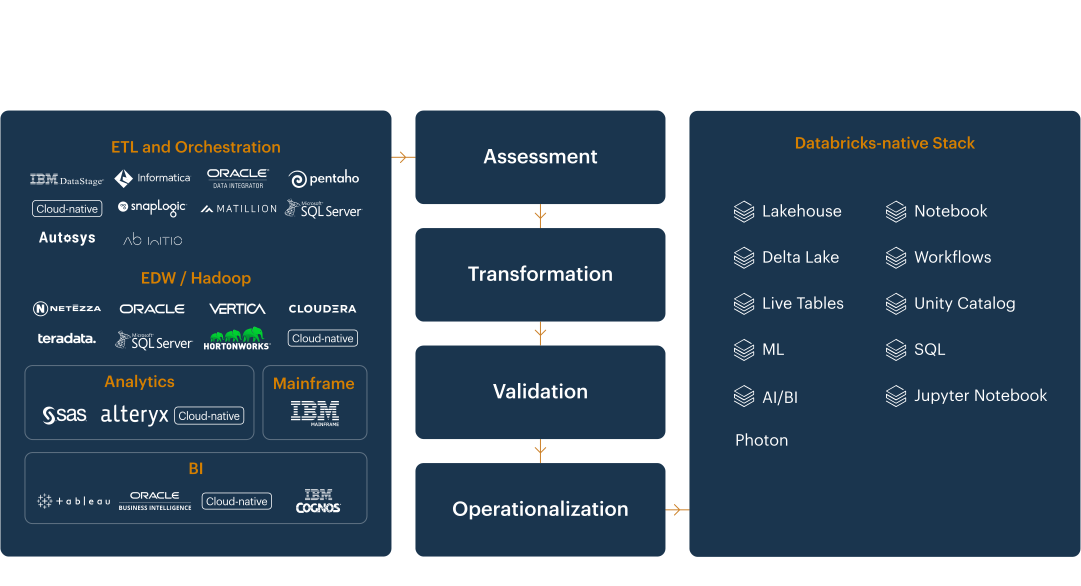
Detailed automated assessment
LeapLogic goes beyond basic assessments by offering a variety of specialized analyses to ensure a thorough understanding of your environment and facilitate a smooth migration. These include:
- Code & SQL assessment: Analyzes patterns, complexity, and optimization opportunities in SQL and non-SQL code, including Hive, Spark, Impala, Presto, and Databricks.
- Metastore & catalog assessment: Evaluates metadata and schema details from Hive Metastore, Glue Catalog, and Unity Catalog. This includes assessing databases, tables, users, data sizes, and permissions.
- Data pipelines and orchestration workflow assessment: Assesses workflow patterns from Airflow, Control-M, Oozie, and NiFi to identify dependencies and process flows. ·
- Lineage analysis: Identifies workflow, process, and data dependencies to inform migration wave planning and application development.
- Data assessment: Categorizes data into ‘Hot,’ ‘Warm,’ ‘Cold,’ and ‘Frozen’ datasets based on usage patterns for efficient migration.
- Resource consumption and utilization analysis: Assesses cluster resource usage to optimize allocation and manage oversized or congested workloads.
- Assessment reports: Generates comprehensive reports covering license audits, migration inventories, wave planning, and resource consumption.
Automated transformation
LeapLogic ensures end-to-end conversion of all workloads, including DML, DDL, views, procedural code, and custom scripts, to specific Databricks services:
- SQL transformation: Converts SQL workloads from Hive, Spark, and other platforms to Databricks SQL, applying optimization techniques like bloom filters and Z-order indexes.
- Code transformation: Migrates non-SQL workloads, including MapReduce and Spark jobs, to Databricks notebooks.
- Pipeline and framework transformation: Transforms ETL frameworks and data pipelines to Databricks Delta Live Tables and Workflows.
- Catalog & metastore migration: Moves metadata from Hive and Glue catalogs to Unity Catalog.
- Customization support: Handles custom functions and column mappings.
Automated validation and testing
LeapLogic ensures data integrity through rigorous automated validation:
- Syntax validation: Confirms compatibility with Databricks syntax.
- Functional validation: Compares counts and results between source and target systems.
- Comprehensive validation: Detailed validation of code, schema, and data.
Operationalization and go-live
LeapLogic supports the final migration phase by facilitating seamless integration with Databricks-native tools and CI/CD practices, ensuring the transition aligns with modern development workflows. Additionally, it implements best practices for performance optimization, focusing on cost-effective solutions that enhance the efficiency and effectiveness of your Databricks environment.
How LeapLogic provides a distinct competitive advantage
LeapLogic offers unparalleled benefits throughout the modernization journey, setting it apart from other migration tools. Here is what business decision-makers and technical teams can benefit from using LeapLogic:
To business decision-makers
- Cost savings: LeapLogic reduces migration costs by over 50% compared to manual methods, saving time and resources.
- Effort reduction: Automates 80-95% of the migration process, significantly cutting down manual effort and risk.
- Investment preservation: Retains and reuses existing investments in legacy systems.
- Reduced technical debt: Lowers complexity and constraints by leveraging Databricks’ on-demand, elastic architecture.
- Optimized performance: Ensures a controlled price-performance ratio with intrinsic optimizations.
- Proven efficiency: Transforms thousands of legacy scripts and jobs to cloud-native equivalents within weeks.
- Risk-free migration: Guarantees a seamless transition with no business disruption and production-ready code within predefined SLAs.
To tech teams
- Comprehensive assessment: Identifies entire inventory, workload complexity, and interdependencies, forming a robust migration plan.
- Lineage and interdependencies:
- Visualization: LeapLogic provides a detailed, interactive lineage graph, showing complex interdependencies between workloads, data, and processes using a repeatable, verifiable DAG-based approach.
- Optimization: Identifies and resolves technical debt at all levels, from architecture to code and orchestration, using Databricks-native solutions like Bloom filters, ZOrder indexes, and more.
- Code maintainability: Ensures minimal legacy footprint through end-to-end transformation of various workloads (e.g., SQL, procedural code, SAS, Alteryx, custom scripts) into maintainable and scalable Databricks-native formats like Lakehouse, Unity Catalog, and Delta Live Tables.
- Architectural flexibility: Supports multiple data interaction models, including Databricks Lakehouse-only, Unity Catalog-based, and hybrid approaches with external data sources tailored to specific organizational needs.
- Production readiness: Delivers verified, performance-tuned, and operational code ready for production, incorporating agile DevOps and CI/CD practices for seamless integration and go-live.
How LeapLogic scores over manual migration
50% more efficient
Reduces effort and preserves existing investments.
95% automated
Seamlessly transforms legacy workloads to Databricks-native.
Cost-effective
Optimizes cost with a controlled price-performance ratio.
Proven scalability
Migrates thousands of scripts to cloud-native in weeks.
Risk-free
Ensures zero disruption and production readiness within SLAs.
Conclusion
Migrating to Databricks Lakehouse with LeapLogic is more than a technical upgrade – it’s a strategic leap forward. By automating the migration process, LeapLogic reduces costs, minimizes effort, and ensures a smooth, risk-free transition. For organizations ready to unlock the full potential of their data, LeapLogic provides a clear path to innovation, driving smarter decision-making and enabling agility in a rapidly evolving digital landscape. Modernization with LeapLogic is the first step in harnessing the power of advanced analytics, setting the foundation for future-ready data strategies.
As 2024 Databricks Migration Partner of the Year and an Elite Databricks Partner, Impetus has helped multiple Fortune 500 companies modernize their data platforms to Databricks, leveraging industry best practices for seamless and optimized migrations. We are uniquely positioned to empower ‘the intelligent enterprise’ with advanced cloud engineering, data engineering, and GenAI solutions.
Ready to revolutionize your data landscape? Contact us today to start your seamless migration to Databricks with LeapLogic.

