The New Race isn’t Cloud, it’s Intelligence: Why Data Estate Modernization is the Backbone of AI Success
Enterprises have focused on becoming “cloud-first” for a decade now. From migrating infrastructure to data to storage to workloads, the shift from legacy to the cloud was the way forward.
Enter 2026: The path has changed. The goals have changed.
Although most large organizations have achieved cloud presence, in 2026, modernization roadmaps are being revamped in line with enterprise AI goals.
The question leaders are asking is: “If we already modernized, why are we doing it again?”
The answer: Cloud adoption was only phase one.
Now the competitive battleground is intelligence.
Even cloud-hosted legacy systems often leave data siloed, duplicated, or slow to reach decision-makers, limiting real-time insights and AI potential.
Cloud infrastructure alone cannot deliver actionable intelligence or drive AI success. This is where data estate modernization comes into the picture.
This blog explores why continuous data modernization matters and how Impetus LeapLogic enables AI-ready, intelligence-driven enterprises.
In 2026, leveraging the cloud is a baseline, not a differentiator
Migrating to the cloud offered numerous benefits to enterprises, including:
- Elastic scalability
- Reduced infrastructure and maintenance costs
- Faster deployment cycles
- Improved accessibility and collaboration
- Enhanced disaster recovery and business continuity
- Better performance optimization
- Increased innovation speed
However, cloud environments alone don’t make organizations intelligent. Many enterprises realized that while they had moved to platforms moved to, modern platforms, their data ecosystems remained disconnected, with limited visibility and accessibility for both humans and AI. In short, companies modernized where data lived – but not how it created business value. This realization has pushed enterprise data modernization back onto executive agendas.
What’s changed since the first data modernization wave?
Let’s go back to 2015-2022. Back then, data modernization meant just that – migration and consolidation of data, storage, workloads, etc.
The shift primarily focused on data warehouse and database modernization efforts.
The goal: Efficiency, scale, and cost optimization.
However, a new wave came in 2023 – and the environment shifted significantly, with:
- Explosion of AI and GenAI adoption
- Real-time analytics becoming an expectation, not a luxury
- Hyper-personalized customer experiences becoming the norm
- Stricter regulatory and compliance pressures
- Faster product and innovation cycles
This major shift made enterprises understand a hard truth: A cloud-hosted legacy data ecosystem is still legacy.
Now, in 2026, the shift is toward Agentic AI. It’s not all about generating content anymore, the focus is more on leveraging AI to plan, decide, and execute multi-step tasks autonomously. Enterprises are moving from “AI as a tool” to “AI agents as a digital workforce.”
As a result, enterprises are elevating their modernization efforts.
What began as legacy data warehouse modernization is now evolving into continuous modernization of the entire data, analytics, BI and AI ecosystem.
The challenge: An ever-evolving intelligence gap
Digital infrastructure does not guarantee accessible, trustworthy, AI-ready data. This intelligence gap in enterprises appears in several ways, such as:
- Poor data quality leading to inconsistent AI model outputs
- Increasing duplication and costs due to fragmented pipelines
- Delayed, inaccurate insights from batch-only processing
- High compliance risks due to governance and lineage gaps
The solution: Re-architecting the data foundation itself.
This can be achieved through structured enterprise data modernization, beginning with a strong data landscape assessment and supported by the right data modernization tools.
What data estate modernization means in 2026
Data modernization is not a one-time migration project. It is an ongoing, continuous evolution of the entire enterprise data ecosystem.
It extends beyond traditional enterprise data warehouse (EDW) modernization or isolated BI modernization initiatives. Instead, it unifies them.
The key characteristics include:
1. Unified data platforms – breaking silos
Delivering a single source of truth with real-time access to teams across the enterprise.
What this enables:
- Improved operations and performance
- Reduced data duplication and reconciliation effort
- Accurate, comprehensive cross-functional analytics instead of department-specific reporting
- Improved global accessibility with consistent definitions and metrics
2. Governance by design – not as an afterthought
Data and analytics modernization ensures governance is embedded directly into pipelines and platforms.
What this enables:
- Accurate, faster compliance with evolving regulations
- Improved audit trail transparency and data traceability
- Higher data trust and reduced reporting risk
- Secure self-service without compromising control
3. AI-ready architectures – built for true intelligence
Data estates are structured to support advanced analytics, machine learning, GenAI and agentic AI workloads from day one.
What this enables:
- Faster model training and deployment
- Better accuracy through clean, contextualized data
- Seamless integration of structured and unstructured sources
- Scalable experimentation without re-architecting later
4. Automation and self-service capabilities – for speed with control
Enabling automation ensures seamless schema conversion, pipeline generation, testing, and orchestration. Additionally, intuitive interfaces allow business users to explore and analyze data independently.
What this enables:
- Reduced IT bottlenecks and faster analytics cycles
- Consistent standards despite decentralized usage
- Lower operational overhead and maintenance effort
- Empowered business teams without governance compromise
In essence, data estate modernization in 2026 is automated, intelligent, and continuous.
The lingering question: Why now?
The urgency is no longer driven by technology trends; it is driven by real-world risks.
Enterprises that delay data estate modernization are not just postponing improvement – they are actively accumulating disadvantages that compound every quarter.
1. Decision velocity
Many enterprises are shifting towards real-time analytics and AI-assisted decisions, while some work with fragmented, unstructured data estates and still struggle with inaccurate data and hindsight metrics.
The gap is not in insight quality alone – it is in speed of action.
2. AI-readiness window & ecosystem maturity
AI adoption is accelerating at an exponential rate. But, so are AI models, agents, copilots, and autonomous analytics systems.
The bar for data readiness is rising and evolving every day.
That’s why, delaying modernization means entering the AI ecosystem late, with fragmented and unreliable data foundations. As a result, losing the chance to build strong, context-aware data intelligence early.
3. Talent gaps
Modern data professionals expect automated pipelines, Lakehouse architectures, and self-service tooling. Legacy or partially modernized environments create friction, increasing attrition and making hiring and upskilling harder.
4. Regulatory and governance preparedness
Data regulations and audit expectations are tightening globally. Waiting increases the probability of rushed compliance efforts, higher remediation costs, and reputational exposure.
5. Cost lock-In
Legacy data architectures and poorly optimized cloud estates become progressively more expensive to maintain. Delaying modernization often leads to technical debt, while transformation costs continue to rise.
6. Innovation cycles
Any market opportunity – from new digital products to data partnerships to platform ecosystems – usually have short windows.
Without a modern data foundation, enterprises may spot opportunities, but lack the readiness to act.
Delaying no longer means “waiting for maturity.”
It increasingly means entering the next wave of digital competition after the standards, leaders, and expectations have already been set by others.
The time to act is now.
Enterprises need to adapt to the evolving AI and agentic landscape with a structured, automation-led approach to data estate modernization.
The Impetus LeapLogic approach: Intelligent legacy data modernization
Meet Impetus LeapLogic – redefining how enterprises modernize data estates at scale.
The path to data modernization can be challenging, including numerous risks, fear of business disruption, or years of manual effort.
Here’s where Impetus LeapLogic stands apart.
Its intelligent engine and a four-step methodology enable businesses to modernize to an elastic, scalable environment without business disruption – in the fastest possible timeframe.
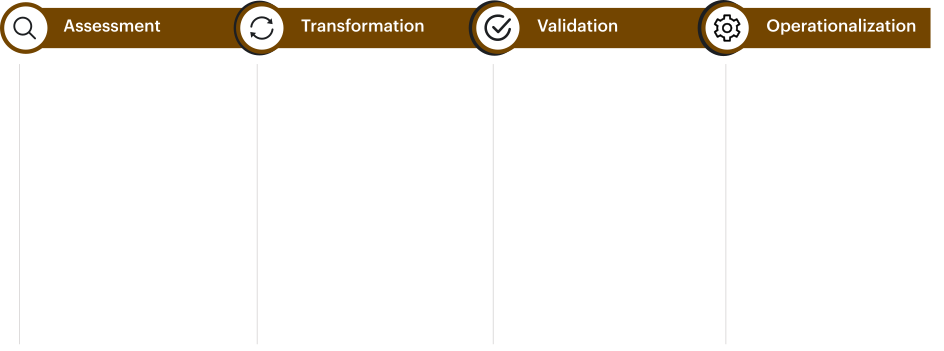
Step 1: Assessment
In this stage, Impetus LeapLogic performs comprehensive, automated assessment of workloads, code profiling, and dependencies.
The benefit: An in-depth blueprint for phased migration, revealing hidden risks, bottlenecks, and optimization opportunities.
Step 2: Transformation
Enabling automated data modernization, the tool converts legacy workloads into cloud-native equivalents while preserving business rules.
The benefit: Accelerating modernization and ensuring high accuracy during conversion.
Step 3: Validation
After the transformation stage, it validates data at row, schema, and business-rule levels, ensuring parity between source and target environments.
The benefit: Reduced business risk and faster AI-driven decision systems.
Step 4: Operationalization
Lastly, the solution packages modernized workloads with orchestration, automation, and DevOps-ready artifacts.
The result: Optimal price-performance ratio with faster decommissioning of legacy systems.
Measurable Business Outcomes with Impetus LeapLogic
Impetus LeapLogic isn’t just a tool for faster migration, it focuses on tangible, broad-level business impact. The data estate modernization tool enables enterprises to innovate faster, operate smarter, and unlock new value streams.
1. Accelerated time-to-intelligence
- Reduces conversion cycles from months to weeks -> Earlier AI and analytics deployment.
- Faster access to trusted data -> Reduces decision loops across leadership, operations, and customer teams.
2. AI, GenAI, and Agentic AI performance gains
- Structured, contextualized datasets -> Improves model accuracy, training speed, and explainability.
- Faster transition from experimentation to production-grade AI initiatives.
- Safer deployment of context-aware AI agents for specialized tasks.
3. Operational efficiency at scale
- Standardized orchestration and DevOps-ready outputs -> Supports continuous modernization instead of one-off upgrades.
- Reduces licensing and maintenance overheads and simplified onboarding of new data sources.
4. Sustainability and cost transparency
- Optimized storage, compute utilization, and workload right-sizing -> Lower cloud waste and energy consumption.
- Brand trust and ethical AI Strong governance and traceability -> Reduces hallucinations and context drift, while improving explainability for responsible AI adoption.
Real-world Enterprise Impact and Data Modernization Use Cases
When data estate modernization is done right, its impact extends far beyond IT transformation – it reshapes how entire industries operate, compete, and innovate.
| Industry | Capability | Benefit |
|---|---|---|
| Healthcare | One dashboard for patient history, diagnostics, and real-time vitals |
|
| Longitudinal data and AI models |
|
|
| Harmonized disparate datasets |
|
|
| Improved hospital throughput |
|
|
| Financial Services | Real-time transactions and behavioral signals analysis |
|
| Unified customer and behavioral data |
|
|
| Embeds lineage, traceability, and automated reporting |
|
|
| Low-latency, consolidated datasets |
|
|
| Manufacturing | IoT sensor data and historical performance |
|
| End-to-end visibility into inventory, logistics, and demand patterns |
|
|
| Analytics and computer vision |
|
|
| Integrates shop floor and enterprise data |
|
|
| Travel & Hospitality | Dynamic pricing (based on seasonality, demand, and competitor signals) |
|
| Loyalty, preference, and behavioral data analysis |
|
|
| Occupancy, staffing, and route prediction |
|
|
| Identifying suspicious transactions and booking pattern |
|
Across industries, the pattern is clear: modernized data estates unlock predictive, real-time, and AI-driven capabilities that directly influence revenue, efficiency, and customer satisfaction. These are intelligence outcomes – not just infrastructure wins.
Modernization 2.0: Redefining “Modern” Enterprises
“Modern” is no longer being in the cloud – it means having a unified, governed, and AI-ready data estate that continuously evolves with the business.
Rather than treating modernization as a risky, one-time migration project, tools like Impetus LeapLogic deliver a structured, automated approach that enables enterprises to modernize end-to-end data and analytics ecosystems with speed, accuracy, and minimal disruption.
Enterprises that combine continuous modernization with automation platforms like Impetus LeapLogic move beyond infrastructure upgrades to build intelligence-ready enterprises – turning fragmented data into a scalable, governed, and growth-driving asset.
If modernization is back on your agenda, now is the time to explore the Impetus LeapLogic journey and talk to an expert about building an intelligent, AI-ready data estate.
Data Estate Modernization: FAQs (2026 Edition)
-
How are data modernization and data migration different?
Data migration is focused solely on moving data from one environment to another.On the other hand, data modernization involves leveraging automation tools, like LeapLogic, and following end-to-end processes to become a future-ready enterprise.
-
Why is data estate modernization important for enterprises today?
With the AI landscape constantly evolving, enterprises must modernize their entire data estate to minimize technical debt, reduce infrastructure costs, and boost performance. -
What types of data platforms can Impetus LeapLogic modernize?
It can modernize legacy data warehouse (Oracle, Vertica, Teradata, SQL Server, etc.), ETL (Informatica, Pentaho, Ab Initio, DataStage, etc.), B (Cognos and Oracle OBIEE), analytics (SAS and Alteryx), Mainframe (IBM Mainframe), and Hadoop (Cloudera, Apache Spark, Hive, etc.) workloads to leading native cloud platforms, such as AWS, Databricks, Google Cloud, Azure, and Snowflake. You can check out more details here.Impetus LeapLogic also offers cloud-to-cloud modernization.
-
How do you assess data estate readiness?
Impetus LeapLogic assesses data estate readiness by analyzing existing data platforms, workloads, and dependencies and defining a clear modernization roadmap. -
How does Impetus LeapLogic support governed and compliant data modernization?
Impetus LeapLogic supports governed and compliant data modernization by capturing metadata, lineage, and dependencies throughout the modernization process. -
Is Impetus LeapLogic designed for large enterprise data environments?
Yes. The tool is built for complex, enterprise-scale modernization initiatives.

